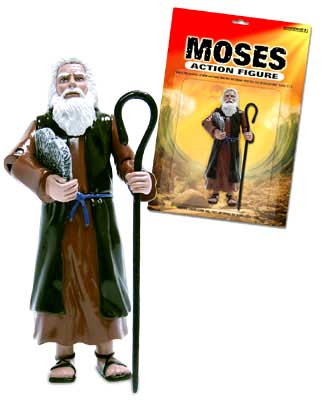
 Chapters 1-4
Chpt. 1 - Nice try, Pharaoh - this is the account of how Pharaoh tried to put the kibosh on the increasing numbers of Israelites. He tells some midwives to kill any male babies. The midwives disobey him, and when confronted about it, seem to be less than truthful. Does the end justify the means here? Doesn't the Bible command us to obey the governing authorities over us and to not lie? Yet v.20 says God was kind to them and blessed them with their own families.
First, we are to obey the governing authorities up to the point that it contradicts a fundamental command of God - they chose to obey God rather than man
since Pharaoh's order contradicted a fundamental divine command (see Gen. 1:28; 9:1, 7). All life belongs to God, and consequently He is the only person who has the right to take it or to command when others should take it. If a boss wants you to go to a strip club to close a business deal, you have the authority from God to say "no," as that would violate God's commands about sexual immorality (see Job 31:1, 1 Thess. 4:3, Matt. 5:28). Be aware, also, that this boss will probably fire you - obedience usually costs.
Second, did the midwives lie? We don't know. Maybe they are correct that Israelite women deliver quickly. Maybe they weren't getting there as fast as they could. Or maybe they did bend the truth. If the last option is the case (they lied), then this passage is problematic. Here's a great Bible study lesson, however: never let 5 clear passages overrule 1 problematic passage. There are other problematic passages in the Bible beside this one (and this one may not really be problematic because we don't know what the truth is), but that doesn't automatically mean the Bible or God is wrong. Never allow an unclear passage to overrule a clear passage.
Finally, Pharaoh's first plan of killing the male babies doesn't work. His second plan of putting the male babies in the Nile also backfires. In fact, it is the mechanism that God uses to raise up Moses, who will lead His people back to the Promised Land. Again, like in Genesis, we see God providentially maneuvering situations to accomplish His will (and man cannot stop it).
Chpt. 2 - Cool start, Not Great in the Middle - Moses has this miraculous start to his life: he's put in the Nile, picked up by Pharaoh's daughter, and then somehow gets returned to his own mother to nurse. I can't imagine the emotion from Moses's mom - she has to give up her newborn son to float away (probably to die) and then a while later a rep from Pharaoh's daughter picks her to nurse a baby that was found in a basket in the Nile - and it turns out to be her son!!!
A couple of notes to the next scene of Moses's life (where he kills the Egyptian):
- Glancing this way and that and seeing no one (v.12) - if you have to look around to make sure nobody is watching what you're about to do, you probably shouldn't do it.
- What I did must have become known (v.14) - everything I do is being watched and will be known. Is that scary? Yes. This knowledge should cause righteous fear in me - it's a tool God can use to help me avoid sin. I know we're not to walk around afraid of God all day (as if He's trying to "get us"), but we have certainly lost any concept of the fear of God or of the idea that we will be judged.
Chpt. 3 - I AM - God tells Moses at the burning bush to go back to both the Israelites and to Pharaoh and let them know that they are outta there. Moses, naturally, thinks, "The last time I dealt with Pharaoh, he wanted to kill me (that's how I got out here). And the last anyone knew of me back home, I was in Pharaoh's family (meaning he would probably not be well-received by the Israelites)." The thing that seemed to inspire him was who was telling him to go - I AM. God did not identify Himself as "I WAS the God of Abe, Isaac & Jacob." I AM implies that He still is today (and will be tomorrow). In other words, Moses has a chance to align himself with God today - the same God who had shown Himself very faithful to Moses's ancestors. What God was asking him to do was surely a daunting task, but he would not be doing it alone. Is God asking us to do something daunting today? Have we considered again today that HE IS? He is not a God who used to do amazing things in Biblical times.
Chpt. 4 - God's Not Really Into Bargaining Too Much - Even after God does 3 miracles to show Moses how he can explain to the Israelites that he is speaking on behalf of God, Moses tells God, "Get someone else. I ain't a good talker." God brings Aaron in on the deal, but it's still Moses driving this train - Aaron is simply the mouth sometimes. A principle here is that God will not ask us to do something that He will not also equip us to do.
Then, in verses 24-25, a CRAZY story happens - God is about to kill Moses. Why? Because Moses had not circumcised his son. There seems to be 2 principles here: (A) God wants obedience in all areas of our lives. If we honor Him in 1 area (i.e. going to talk to Pharaoh and/or the Israelites), but we dishonor Him by overlooking a clear command (i.e. circumcision), He doesn't give us a pass on the disobedience. Add to that this idea: circumcision was an outward sign of an inward truth: to be circumcised is to be set apart to God. Moses was about to do something VERY difficult and he would need a daily reminder that he had been set apart for this purpose. (B) God wants us to be the same at home as we are in public for Him. If Moses's family was not fully trusting God (as circumcision would've given evidence of), then why would Moses get up in front of the Israelites (or Pharaoh) and tell them to fully trust God? While this story seems odd, I just think God is trying to get Moses's attention and get him laser-beam focused on obeying God. God knew what lay ahead and how hard it would be, so he needed a leader who was committed.


1 comment:
I think about reading these then i start scroll and scroll and scroll and then my mind is somewhere else and i can't read, so i am just gonna look at the pictures then when you get home you can tell me what it said...
deal!! I love you and all your words (even though I don't read them all!)
Post a Comment